Are You Looking For An Experienced Mortgage Professional In Vancouver?

My goal is to make your home ownership dreams come true.

LET'S TALK

ANNA SMITH

Happy Client

" Deb is fantastic to work with and refer to clients because she is fast, efficient and reliable. It is a pleasure to spread the good word of her enthusiastic work, helping clients with their new home purchases.  Deb is not one to give up easily; she will work long and hard for her clients to get a solid outcome for them. "

Finding the best mortgage can be frustrating. It doesn't have to be when you follow my 3 step plan.

White background with the number 1 in the top left corner.

STEP ONE

Connect with me! 

The process starts when you get in touch. Let's take a look at your financial situation and put together a plan for your first/next mortgage!


2

STEP TWO

Discuss your options.

When it comes to mortgage financing, you have options! Let's clarify those options, so you can make the best decision for your needs.

Number "3" in the top left corner.

STEP THREE

The Paperwork.

Paperwork is the nitty gritty of mortgage financing. I'll make sure you know exactly what is required of you at every step, limiting any delays.

A number "4" in black text against a white background.

STEP FOUR

Lifetime support.

Once I've arranged your mortgage, I'm not going anywhere! As long as you need a mortgage, you can trust that I'll be there to give you a hand.


Curious about what you might be able to afford?

Find out how much you can afford in 30 seconds.

CALCULATE
Woman with curly dark hair, turquoise glasses, smiling, wearing colorful floral top.

Deborah Burnstein Mortgage Specialist

A Better Way - Mortgage Architects

C 604.202.7493
Email 
deb@debsmortgages.ca

Deb Burnstein

Deb is proud to be an original Vancouverite. She has come to the mortgage financing business via a very successful career in corporates sales including financing products. Her dedication to customer satisfaction and long-term relationships has paved the way to her success. Whether she is working with a first-time home buyer or helping seniors enhance their retirement income deb has the patience and compassion to guide all to a successful outcome.


Along with her passion for making her clients happy she enjoys outdoor activities like golfing, snowshoeing, and kayaking but can also be found travelling or at a music concert with family and friends. When not outside she is usually taking care of her insides with yoga and chocolate (not necessarily in that order).

Nice things people have said about working with me.

Get started by completing my online mortgage application.

APPLY NOW

I'll let you know exactly where you stand so you can proceed with confidence.

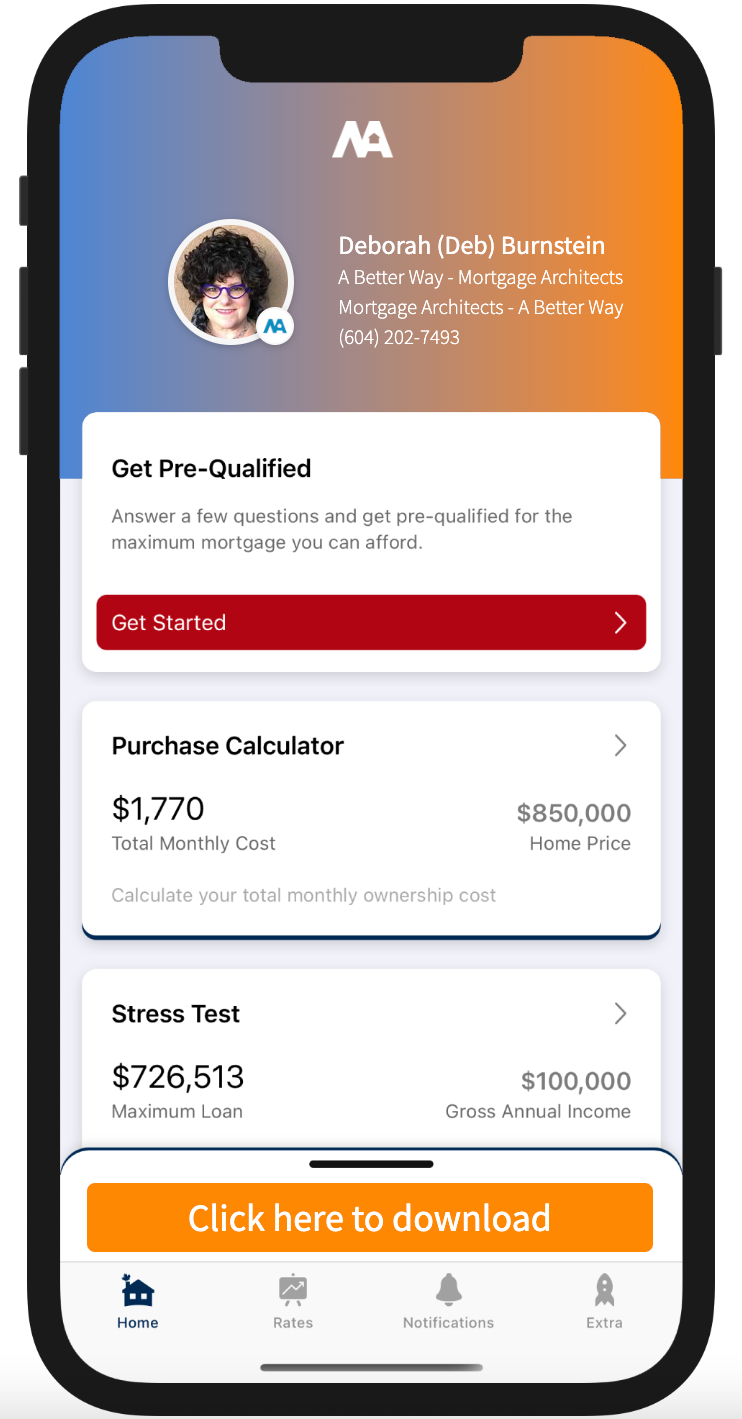
Download my Mortgage Toolbox App

What you can do with my app


Calculate your total cost of owning a home

Estimate the minimum down payment you need

Calculate Land transfer taxes and the available rebates.


  • Calculate the maximum loan you can borrow
  • Stress test your mortgage
  • Estimate your Closing costs
  • Compare your options side by side
  • Search for the best mortgage rates
  • Email Summary reports (PDF)
  • Use my app in English, French, Spanish, Hindi, and Chinese
Get it on Google Play button with Google Play icon.

Contact me


Contact Us

Get in touch


I'm committed to helping you in any way I can. Leave me a note and I'll get in touch with you shortly.

A black phone icon with sound waves indicating a call.
Envelope icon.

Everything you need, all in one place

As a trusted mortgage provider, let me help you with these services.

Click through any of the services to learn more

Mortgage articles to keep you informed.

Man with glasses smiles while using a smartphone and laptop at a desk.
By Deb Burnstein December 31, 2025
Fixed vs. Variable Rate Mortgages: Which One Fits Your Life? Whether you’re buying your first home, refinancing your current mortgage, or approaching renewal, one big decision stands in your way: fixed or variable rate? It’s a question many homeowners wrestle with—and the right answer depends on your goals, lifestyle, and risk tolerance. Let’s break down the key differences so you can move forward with confidence. Fixed Rate: Stability & Predictability A fixed-rate mortgage offers one major advantage: peace of mind . Your interest rate stays the same for the entire term—usually five years—regardless of what happens in the broader economy. Pros: Your monthly payment never changes during the term. Ideal if you value budgeting certainty. Shields you from rate increases. Cons: Fixed rates are usually higher than variable rates at the outset. Penalties for breaking your mortgage early can be steep , thanks to something called the Interest Rate Differential (IRD) —a complex and often costly formula used by lenders. In fact, IRD penalties have been known to reach up to 4.5% of your mortgage balance in some cases. That’s a lot to pay if you need to move, refinance, or restructure your mortgage before the end of your term. Variable Rate: Flexibility & Potential Savings With a variable-rate mortgage , your interest rate moves with the market—specifically, it adjusts based on changes to the lender’s prime rate. For example, if your mortgage is set at Prime minus 0.50% and prime is 6.00% , your rate would be 5.50% . If prime increases or decreases, your mortgage rate will change too. Pros: Typically starts out lower than a fixed rate. Penalties are simpler and smaller —usually just three months’ interest (often 2–2.5 mortgage payments). Historically, many Canadians have paid less overall interest with a variable mortgage. Cons: Your payment could increase if rates rise. Not ideal if rate fluctuations keep you up at night. The Penalty Factor: Why It Matters More Than You Think One of the biggest surprises for homeowners is the cost of breaking a mortgage early —something nearly 6 out of 10 Canadians do before their term ends. Fixed Rate = Unpredictable, potentially high penalty (IRD) Variable Rate = Predictable, usually lower penalty (3 months’ interest) Even if you don’t plan to break your mortgage, life happens—career changes, family needs, or new opportunities could shift your path. So, Which One is Best? There’s no one-size-fits-all answer. A fixed rate might be perfect for someone who wants stable budgeting and plans to stay put for years. A variable rate might work better for someone who’s financially flexible and open to market changes—or who may need to exit their mortgage early. Ultimately, the best mortgage is the one that fits your goals and your reality —not just what the bank recommends. Let's Find the Right Fit Choosing between fixed and variable isn’t just about numbers—it’s about understanding your needs, your future plans, and how much financial flexibility you want. Let’s sit down and walk through your options together. I’ll help you make an informed, confident choice—no guesswork required.
Father and child reading a book together on the floor. White shirt, neutral setting, smiling faces.
By Deb Burnstein December 24, 2025
Going Through a Separation? Here’s What You Need to Know About Your Mortgage Separation or divorce can be one of life’s most stressful transitions—and when real estate is involved, the financial side of things can get complicated fast. If you and your partner own a home together, figuring out what happens next with your mortgage is a critical step in moving forward. Here’s what you need to know: You’re Still Responsible for Mortgage Payments Even if your relationship changes, your obligation to your mortgage lender doesn’t. If your name is on the mortgage, you’re fully responsible for making sure payments continue. Missed payments can lead to penalties, damage your credit, or even put your home at risk of foreclosure. If you relied on your partner to handle payments during the relationship, now is the time to take a proactive role. Contact your lender directly to confirm everything is on track. Breaking or Changing Your Mortgage Comes With Costs Dividing your finances might mean refinancing, removing someone from the title, or selling the home. All of these options come with potential legal fees, appraisal costs, and mortgage penalties—especially if you’re mid-term with a fixed-rate mortgage. Before making any decisions, speak with your lender to get a clear picture of the potential costs. This info can be helpful when finalizing your separation agreement. Legal Status Affects Financing If you're applying for a new mortgage after a separation, lenders will want to see official documentation—like a signed separation agreement or divorce decree. These documents help the lender assess any ongoing financial obligations like child or spousal support, which may impact your ability to qualify. No paperwork yet? Expect delays and added scrutiny in the mortgage process until everything is finalized. Qualifying on One Income Can Be Tougher Many couples qualify for mortgages based on combined income. After a separation, your borrowing power may decrease if you're now applying solo. This can affect your ability to buy a new home or stay in the one you currently own. A mortgage professional can help you reassess your financial picture and identify options that make sense for your situation—whether that means buying on your own, co-signing with a family member, or exploring government programs. Buying Out Your Partner? You May Have Extra Flexibility In cases where one person wants to stay in the home, lenders may offer special flexibility. Unlike traditional refinancing, which typically caps borrowing at 80% of the home’s value, a “spousal buyout” may allow you to access up to 95%—making it easier to compensate your former partner and retain the home. This option is especially useful for families looking to minimize disruption for children or maintain community ties. You Don’t Have to Figure It Out Alone Separation is never simple—but with the right support, you can move forward with clarity and confidence. Whether you’re keeping the home, selling, or starting fresh, working with a mortgage professional can help you understand your options and create a strategy that aligns with your new goals. Let’s talk through your situation and explore the best path forward. I’m here to help.
Blue and white house with stone accents, white pillars, and a welcoming porch.
By Deb Burnstein December 17, 2025
What Is a Second Mortgage, Really? (It’s Not What Most People Think) If you’ve heard the term “second mortgage” and assumed it refers to the next mortgage you take out after your first one ends, you’re not alone. It’s a common misconception—but the reality is a bit different. A second mortgage isn’t about the order of mortgages over time. It’s actually about the number of loans secured against a single property —at the same time. So, What Exactly Is a Second Mortgage? When you first buy a home, your mortgage is registered on the property in first position . This simply means your lender has the primary legal claim to your property if you ever sell it or default. A second mortgage is another loan that’s added on top of your existing mortgage. It’s registered in second position , meaning the lender only gets paid out after the first mortgage is settled. If you sell your home, any proceeds go toward paying off the first mortgage first, then the second one, and any remaining equity is yours. It’s important to note: You still keep your original mortgage and keep making payments on it —the second mortgage is an entirely separate agreement layered on top. Why Would Anyone Take Out a Second Mortgage? There are a few good reasons homeowners choose this route: You want to tap into your home equity without refinancing your existing mortgage. Your current mortgage has great terms (like a low interest rate), and breaking it would trigger hefty penalties. You need access to funds quickly , and a second mortgage is faster and more flexible than refinancing. One common use? Debt consolidation . If you’re juggling high-interest credit card or personal loan debt, a second mortgage can help reduce your overall interest costs and improve monthly cash flow. Is a Second Mortgage Right for You? A second mortgage can be a smart solution in the right situation—but it’s not always the best move. It depends on your current mortgage terms, your equity, and your financial goals. If you’re curious about how a second mortgage could work for your situation—or if you’re considering your options to improve cash flow or access equity—let’s talk. I’d be happy to walk you through it and help you explore the right path forward. Reach out anytime—we’ll figure it out together.
Show More